Flight History
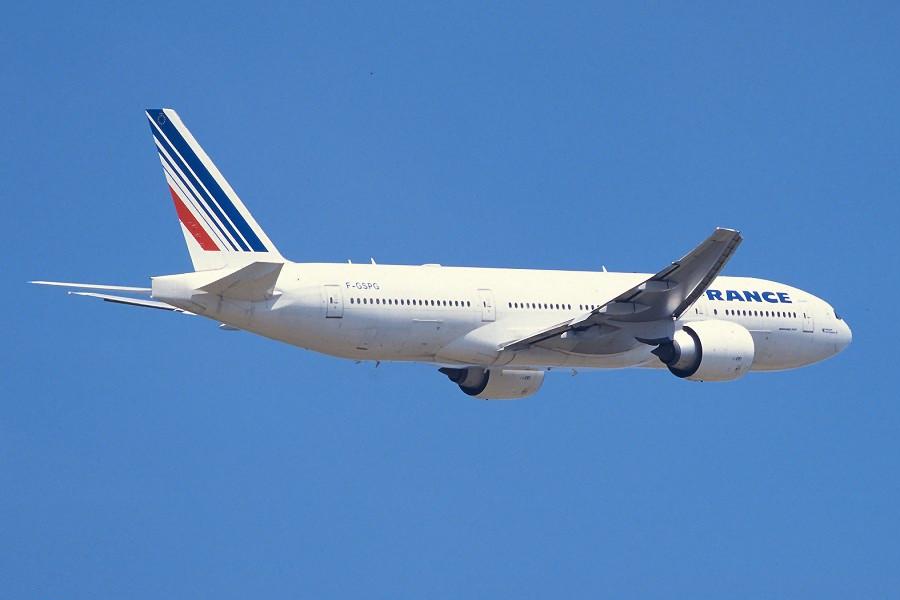
On 2 May 2015, a Boeing 777-228ER registered F-GSPG, operated by Air France, was conducting a commercial passenger flight from Malabo, Equatorial Guinea, to Paris, France, with a stopover in Douala, Cameroon. The leg between Malabo and Douala was flown at flight level 90 (FL90). The crew consisted of a captain (pilot monitoring, PM), a co-pilot (pilot flying, PF), and a relief pilot. There were also 11 cabin crew members and 23 passengers on board. The aircraft departed Malabo at 20:03 UTC from runway 22, initially turning right to heading 030° to join the flight plan route before engaging the autopilot.
Meteorological Conditions and Navigation
During flight preparation, the crew had difficulty obtaining precise weather information for Douala. The flight file indicated cumulonimbus clouds and visibility greater than 10 km at Malabo, while Douala's 17:00 METAR reported a storm, cumulonimbus, and a ceiling of 1,600 ft. The TAF forecast rain showers and reduced visibility. The Operations Control Centre informed the crew that the storm over Douala was moving west and that two aircraft had landed. Shortly after takeoff, the crew observed numerous storm cells on the weather radar along the flight plan route and to the south. The aircraft deviated northwards from the planned route. The PF's navigation display (ND) was set to Weather mode, and the PM's ND was set to Terrain mode.
Warnings and Evasive Maneuver
At approximately 20:14, about ten minutes after takeoff, the aircraft was 6 NM northwest of Mount Cameroon. The PF initiated a right turn to join the DME arc for the approach to Douala. During the turn, at a height of about 5,000 ft, the Enhanced Ground Proximity Warning System (EGPWS) activated a "TERRAIN AHEAD" caution, lasting four seconds. Three seconds later, the PF increased the selected heading to 134°. At 20:14:12, with the radio altimeter height at 4,150 ft, the "TERRAIN AHEAD PULL UP" warning sounded for eight seconds. The NDs turned red. The PF disengaged the autopilot and applied nose-up input, advancing the thrust levers to maximum. The autothrottle was disengaged five seconds later. During the warning, pitch attitude increased to a maximum of 15°, and vertical speed increased. The aircraft remained in the turn. The relief pilot advised leveling the wings.
Aftermath
The warning ceased at 20:14:20. The bank was briefly canceled before the turn resumed. The crew selected FL120 and a heading of 150°. On passing FL110, the PM instructed the PF to stop climbing; the aircraft reached FL120 then continued to FL130. The minimum radio altimeter height during the maneuver was 2,100 ft, corresponding to an altitude of 11,500 ft. Mount Cameroon's summit is 13,202 ft. The crew then resumed navigation to the ILS DME arc for runway 30 at Douala and landed without further incident. No injuries or damage were reported. After debriefing, the crew continued the rotation to Paris.