Flight History
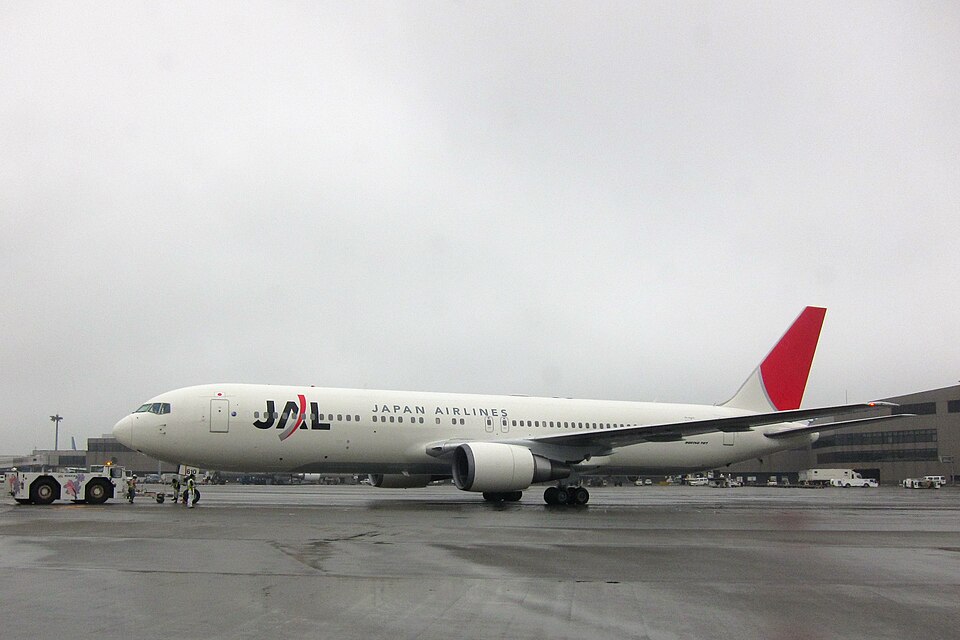
On November 26, 2012, Japan Airlines flight 877, a Boeing 767-300 registered as JA610J, departed Narita International Airport at 14:28 Japan Standard Time bound for Shanghai Pudong International Airport. The aircraft carried 171 occupants: two pilots, ten flight attendants, and 159 passengers. The pilot in command served as pilot monitoring, and the first officer was pilot flying.
After reaching cruising altitude of 36,000 ft, the aircraft flew in thin clouds. At around 14:45, the pilot in command turned off the seatbelt sign, and flight attendants began preparing for in-flight services. Several passengers left their seats to use the lavatories.
At approximately 14:54, while flying over Fujinomiya City, Shizuoka Prefecture, the aircraft encountered severe turbulence. The digital flight data recorder recorded significant vertical acceleration changes: a deceleration to +0.7 G one second after an acceleration to +1.9 G. The first officer immediately turned on the seatbelt sign and initiated a descent to avoid further turbulence.
After the turbulence subsided and the seatbelt sign was turned off, a passenger informed a flight attendant that he had sprained his right ankle while trying to maintain his balance after exiting the aft lavatory. The aircraft landed at Shanghai Pudong International Airport at 17:49, where the passenger was transported to a hospital and diagnosed with a fractured ankle.
Weather Conditions
Meteorological information indicated a deep trough over Japan with a Low pressure system moving eastward. At 300 hPa, two strong wind bands associated with jet streams blew over Japan. The southern jet stream passed through western Japan near the turbulence location. Infrared satellite imagery showed high-level clouds (top height 38,000 ft) forming a Transverse Band, which moved eastward over the turbulence spot. A Bulge developed on the northern edge of the Transverse Band, indicating inflow of warm, humid air. No pilot reports of turbulence in the vicinity were received.
Injuries and Damage
One passenger, a 35-year-old male, sustained a serious injury (fractured ankle). The aircraft was not damaged.
Personnel and Aircraft Information
The pilot in command, aged 55, held an airline transport pilot certificate with a Boeing 767 type rating and had 16,048 total flight hours. The first officer, aged 36, held a commercial pilot certificate with a Boeing 767 type rating and had 5,240 total flight hours. The aircraft, a Boeing 767-300 (serial number 33846, manufactured September 1, 2004), had a total time in service of 31,730 hours. Weight and center of gravity were within allowable limits.