Flight History
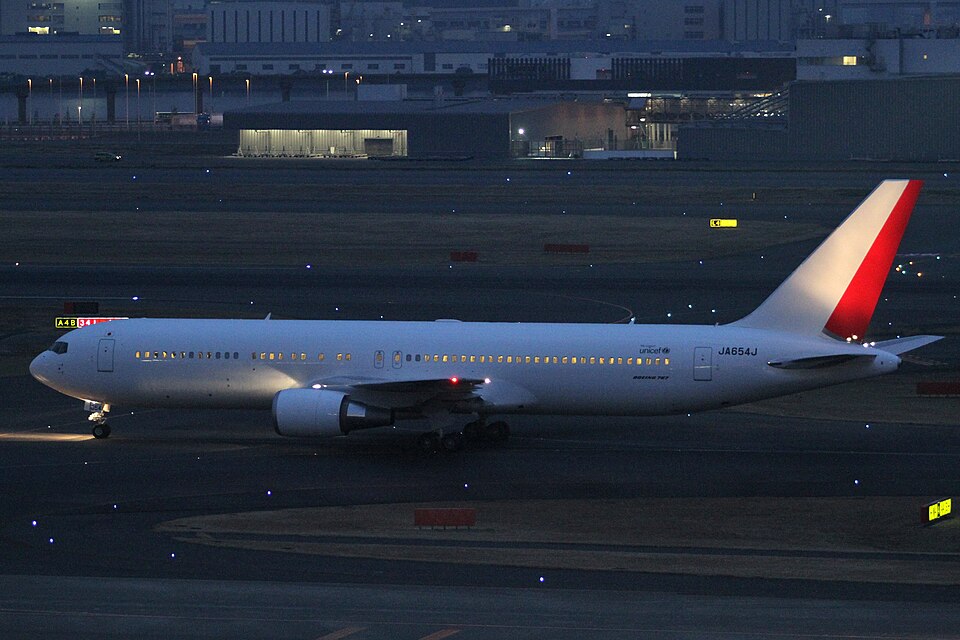
On September 12, 2014, Japan Airlines flight 93, a Boeing 767-300 (registration JA654J), departed Tokyo International Airport at 15:50 JST bound for Gimpo International Airport in Korea. The aircraft carried 230 persons: 2 pilots, 9 other crew members, and 218 passengers. The pilot-in-command (PIC) served as pilot monitoring, and the first officer (FO) as pilot flying.
During descent, at 17:33 JST at an altitude of approximately 16,000 ft near waypoint GUKDO (about 95 km southeast of Gimpo), the aircraft encountered strong shaking lasting about three seconds. The vertical acceleration reached approximately +1.5 G, then momentarily dropped to -0.2 G, followed by +1.3 G. The autopilot and autothrottle remained engaged throughout. The flight crew had been informed earlier by company operation support staff that no significant convective clouds were observed on the approach course, but redevelopment of convective clouds occurred near GUKDO after 17:00.
Injuries
One cabin attendant sustained serious injury after being thrown into the air and falling onto her back. Four other cabin attendants and two interpreters suffered minor injuries. No passengers were injured.
Aircraft and Crew Information
The aircraft, a Boeing 767-300 (serial number 40366, manufactured January 17, 2011), had a total time in service of 15,003 hours. The PIC held an airline transport pilot certificate with Boeing 767 type rating and had 9,243 total flight hours. The FO held a commercial pilot certificate with instrument rating and had 10,924 total flight hours.
Meteorological Conditions
Pre-flight weather indicated a high-pressure system over the Korean Peninsula with no expected bad weather. A weak vertical wind shear existed in the upper layer but not at the accident altitude. Terminal Doppler Weather Radar images from Incheon International Airport showed small echoes to the west of GUKDO that attenuated and then redeveloped near GUKDO after 17:00.
Findings
The investigation determined that the aircraft encountered turbulence from convective clouds. The pilots had difficulty visually identifying the clouds due to restricted visibility in thin clouds, and the airborne weather radar did not display echoes along the flight path because the auto tilt mode may have pointed the beam upward as the aircraft descended, missing the developing clouds below. The cabin crew had completed services and were preparing for landing when the shaking occurred.