Accident Overview
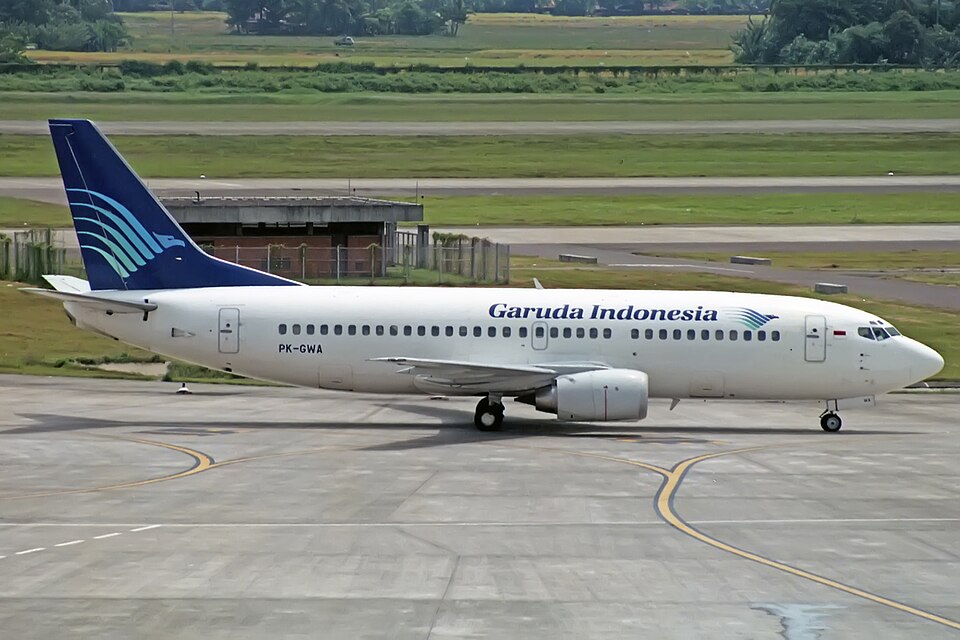
On January 16, 2002, at approximately 09:24 UTC, a Boeing 737-300, registration PK-GWA, operated by PT Garuda Indonesia as Flight GA 421, ditched into the waters of the Bengawan Solo River in Central Java during a forced landing. The aircraft had departed Ampenan at 08:32 UTC on a regular scheduled commercial flight to Yogyakarta. At departure, visual meteorological conditions (VMC) prevailed. The flight from Ampenan was reported uneventful until its arrival in the Yogyakarta area.
Pre-Descent and Weather Encounter
The crew observed cumulonimbus cloud formations on their weather radar. The aircraft descended from cruise altitude of 31,000 ft to 28,000 ft as instructed by BALI ATC at 09:08 UTC due to eastbound traffic at flight level (FL) 290. As they began their descent from FL 280 at 09:13 UTC, prior to entering clouds at 23,000 ft, the crew noted red cells on the radar screen with two green and yellow areas to the left and right of their intended flight path. The pilot flying decided to take the left opening above PURWO NDB. The flight crew prepared for turbulence by setting turbulence speed at 280 knots, seatbelt on, engine ignitions on FLT, and anti-ice on. The pilot flying requested descent to FL 190, which was cleared by Semarang APP at 09:13 UTC.
Engine Flame-Out and Relight Attempts
Shortly after entering the area covered by cumulonimbus cells, the crew noted severe turbulence and heavy precipitation. According to the flight crew interview, they observed loss of aircraft electrical power generators, leaving only primary engine instrument indications and the captain's flight instruments, which finally identified both engines flame-out. While in precipitation, the flight crew attempted at least two engine relights and one APU start. As the APU start was initiated, the crew noted total electrical loss of the aircraft.
Descent and River Landing
The aircraft descended into VMC at about 8,000 ft altitude. The pilot-in-command spotted the Bengawan Solo River and decided to land the aircraft on the river. The crew announced to the flight attendant to prepare for emergency landing procedures. The aircraft landed successfully between two iron bridges in the upstream direction and came to a stop with its nose pointing to the right of the landing path. The aircraft settled on its belly, with wings and control surfaces largely intact, and was partially submerged. The evacuation following the landing was successful.
Injuries
Twelve passengers suffered injuries. The flight crew and two flight attendants were uninjured. One flight attendant suffered serious injuries, and another flight attendant was found in the waters of the river and fatally injured.
Probable Cause
The National Transportation Safety Committee (NTSC) determined that the probable causes of the accident were the combination of: 1) The aircraft had entered severe hail and rain during weather avoidance which subsequently caused both engines flame out; 2) Two attempts of engine-relight failed because the aircraft was still in the precipitation beyond the engines’ certified capabilities; and 3) During the second attempt relight, the aircraft suffered run-out electrical power.