Incident Overview
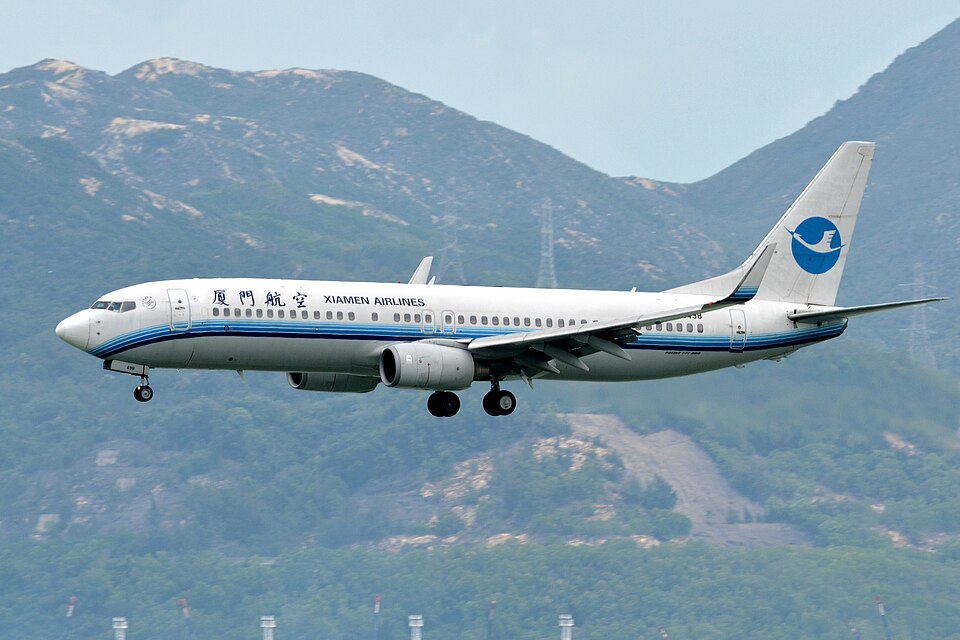
On August 16, 2018, at approximately 1555 UTC (2355 local time), Xiamen Airlines flight CXA 8667, a Boeing 737-800 with registration B-5498, was landing on Runway 24 of Ninoy Aquino International Airport (NAIA) in Manila, Philippines. The aircraft, which had departed from Xiamen, China, as a scheduled commercial passenger flight, sustained substantial damage following a runway excursion after the second approach. None of the 157 passengers, 2 pilots, 5 cabin crew, and 1 air security officer were injured. The flight operated under an instrument flight rules flight plan in instrument meteorological conditions (IMC).
Approach and Landing Sequence
During the first approach, the Captain, who was the pilot flying, aborted the landing at 30 feet radio altitude (RA) due to insufficient visual reference. A second approach was then planned, with a briefing that included the possibility of another aborted landing and a diversion to the alternate airfield. The second approach was stabilized with flaps set at 30 degrees, all landing gear extended, and speed brake lever in the ARM position. The autopilot was disengaged at 1,002 feet RA, followed by the auto-throttle three seconds later. The ILS localizer and glide slope paths were accurately tracked. The reference landing speed for flaps 30 was 145 knots, with a target speed of 150 knots set on the Mode Control Panel.
The vertical descent rate was maintained through Decision Altitude (DA) of 375 feet down to 50 feet RA. As the aircraft crossed the threshold, it began to drift left of the centerline. The First Officer (FO) called for a go-around, but the Captain responded "No." Both throttle levers were reduced to idle at 30 feet RA and became fully idle at 5 feet RA. At 13 feet RA, the aircraft was rolling left and drifting left. The FO again called for a go-around at 10 feet RA, but the Captain replied "No" and "It's Okay." Just prior to touchdown, speed decreased by 4 knots, and the aircraft touched down at 151 knots (VREF+6) with a wind of 274.7 degrees at 8.5 knots.
Runway Excursion and Damage
The aircraft touched down on both main gears, left of the centerline, 741 meters from the threshold of Runway 24. Speed brakes deployed and auto brakes engaged, but the auto brakes later disengaged for an undetermined reason. After touchdown, the aircraft continued leftward while maintaining a heading of 241 degrees. It departed the left edge of the runway at about 147 knots, and all landing gears struck concrete electric junction boxes erected parallel to the runway pavement. The aircraft came to rest approximately 1,500 meters from the threshold at coordinates 14°30'23.7" N, 121°0'59.1" E, with a heading of 120 degrees. The Cockpit Voice Recorder (CVR) recorded two more go-around calls from the FO after touchdown. Thrust reversers were not deployed; there was no evidence of reverse thrust selection.
Post-Event Actions
After the aircraft stopped, the pilots performed memory items and the evacuation non-normal checklist, including extending flaps to 40 degrees. The aircraft suffered total communication loss and failure of the passenger address system, likely due to the nose gear collapsing rearward and damaging equipment in the E/E compartment or breaking the VHF 1 radio battery wire. The Captain directed the FO to announce the emergency evacuation. Cabin crew evacuated passengers using the emergency slides of the left and right forward doors. No injuries were reported.