Incident Overview
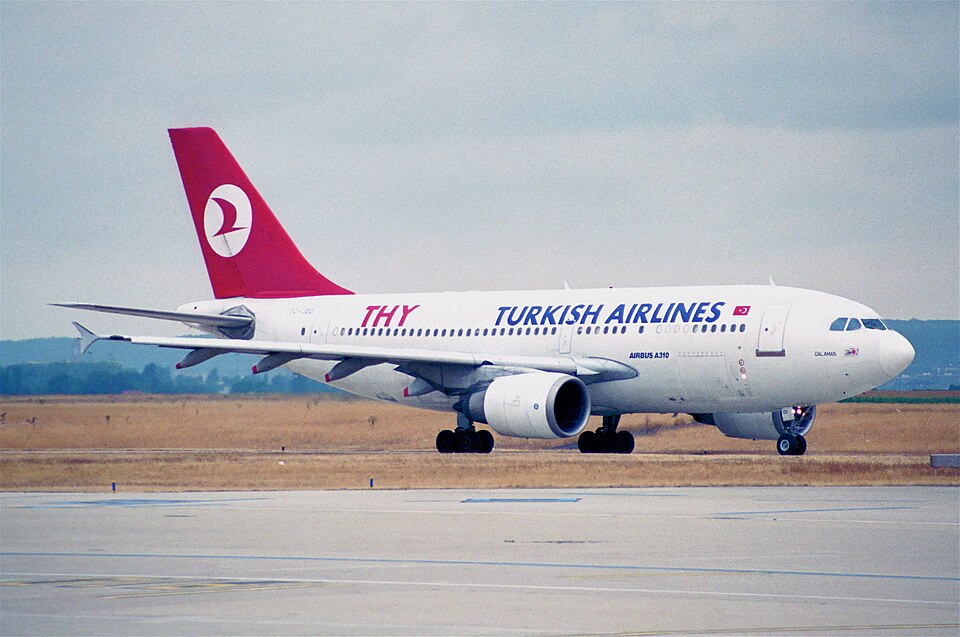
On 13 September 2000 at 11:14 UTC, an air traffic incident (airprox) occurred in the Swiss Upper Information Region (UIR) near the Trasadingen (TRA) waypoint, involving four aircraft: Turkish Airlines flight THY1944 (Airbus A310, registration TC-JDD), Deutsche BA flight BAG4608 (Boeing 733, registration D-ADBR), Iberia flight IBE3514 (Airbus A320, registration EC-FIA), and Alitalia flight AZA467 (Boeing MD80, registration I-DAVJ). The aircraft were operating under IFR in Class C airspace and were in continuous radio contact with the Zurich Radar Upper Sector 1 controller.
Sequence of Events
The four aircraft crossed near TRA within approximately 60 seconds. BAG4608 and IBE3514 overflew TRA almost simultaneously, while THY1944 and AZA467 each crossed about 30 seconds later. The air traffic controller had issued vertical separation instructions for the crossing.
THY1944, the lowest of the four, was climbing to its cleared flight level (FL) 260. Its climb rate reached up to 3000 ft/min in the final phase before reaching FL 260, after which it maintained FL 260 stably.
BAG4608 held FL 270 until about 5 NM before TRA, then followed a Traffic Collision Avoidance System Resolution Advisory (TCAS RA) and climbed briefly to FL 272.
IBE3514 initially held FL 280 but shortly before TRA executed a climb at up to 3500 ft/min to FL 291, also following a TCAS RA.
AZA467, the last to enter the conflict zone, held FL 290 until about 7 NM north of TRA, then followed a TCAS RA climbing at up to 2500 ft/min to FL 295.
The TCAS RAs led to a loss of separation. The minimum separation between the two highest aircraft, IBE3514 and AZA467, was 400 ft vertically and 2.9 NM horizontally as they flew toward each other.
Communications and Response
At 11:14:14, THY1944 reported a traffic alert. The controller informed it that BAG4608 was maintaining FL 270. At that time, THY1944 was passing about FL 255 climbing to FL 260, which it then maintained.
At 11:14:46, BAG4608 reported a TCAS climb. It was already at FL 272. The controller instructed it to descend immediately to FL 270, which it did.
About one minute before the conflict, IBE3514 was instructed to contact Rhine Control but instead contacted Zurich Radar Upper Sector 3 (due to similar frequencies: 132.405 MHz vs 133.405 MHz) at 11:14:54, reporting a TCAS advisory. It was then passing FL 287 and continued to FL 291. The controller informed it that the opposite aircraft (AZA467) was at FL 290 with 1000 ft separation.
At 11:15:23, AZA467 reported a TCAS climb on the U1 frequency, already at FL 295. The controller advised it of the approaching IBE3514 at FL 291.
Cause
The incident was caused by the TCAS on BAG4608 issuing a climb RA due to the high climb rate of THY1944 flying below it in the final phase before reaching its cleared flight level (FL 260).
Findings
- The incident occurred in Class C controlled airspace.
- All aircraft were on IFR flight plans and in continuous communication with the radar controller.
- The controller's instructions for vertical separation were timely and correct.
- All altitude clearances were correctly acknowledged.
- The pilots informed ATC of TCAS RA initiations, but in all cases after the maneuver had begun or after reaching the avoidance altitude.
- The controllers responded optimally by immediately informing the crews of the actual traffic situation.
Measures Taken
On 19 July 2001, the Swiss Federal Office of Civil Aviation published AIC 15/01, containing guidelines for climb and descent rates.