Tail strike during rotation causes substantial damage to pressure bulkhead

Casualties unknown • Santa Ana, CA, US

A flight crew exceeded the recommended pitch rate during takeoff rotation, resulting in a tail strike and significant structural damage to the aircraft's pressure bulkhead upon arrival.

What happened

The aircraft experienced a tail strike while rotating for takeoff. Despite the incident occurring during the initial climb phase, the flight continued to its destination in Las Vegas without immediate diversion. Upon arrival, a post-flight inspection was conducted by maintenance personnel. The examination revealed that there was substantial damage to the pressure bulkhead of the fuselage.

The investigation

Investigators reviewed the company's operational manual requirements for takeoff procedures. The manual explicitly cautions flight crews to limit the initial pitch attitude to between 9 and 10 degrees. Furthermore, it mandates that rotation must be performed smoothly at a maximum rate of 3 degrees per second. To verify compliance with these standards, the data from the Digital Flight Data Recorder (DFDR) was analyzed.

The DFDR readout provided concrete evidence regarding the takeoff technique. The recorded data showed that the actual rotation rate significantly exceeded the operational limit. The aircraft rotated at a rate greater than 7 degrees per second, more than double the maximum allowed speed. This excessive pitch-up rate directly contributed to the main landing gear striking the tail section of the aircraft before liftoff.

Findings

The primary factor in this event was the failure to adhere to established takeoff rotation parameters. The operational manual sets clear limits to prevent structural stress and potential damage during the critical phase of flight. By rotating at a rate exceeding 7 degrees per second, the crew violated the 3 degrees per second limit. This aggressive rotation technique resulted in the tail striking the runway surface.

The resulting impact caused substantial damage to the pressure bulkhead. While the aircraft remained airworthy enough to complete the flight, the structural integrity was compromised. The investigation highlights the importance of smooth control inputs during takeoff. Adhering to the specified pitch attitude and rotation rate is essential for preventing such mechanical failures.

Safety message

Flight crews must strictly adhere to operational manual limits regarding rotation rates. Exceeding the maximum pitch rate can lead to tail strikes and significant structural damage. Smooth, controlled rotations are necessary to ensure safe liftoff and preserve airframe integrity.

Probable cause

The flight crew's excessive rotation rate during takeoff, which exceeded the operational manual limit of 3 degrees per second, resulting in a tail strike and substantial damage to the pressure bulkhead.

All Boeing 737-300 accidents →

Frequently asked questions

What happened in the 1990-03-17 Boeing 737-300 accident near Santa Ana, CA?

A flight crew exceeded the recommended pitch rate during takeoff rotation, resulting in a tail strike and significant structural damage to the aircraft's pressure bulkhead upon arrival.

What aircraft was involved and where did it happen?

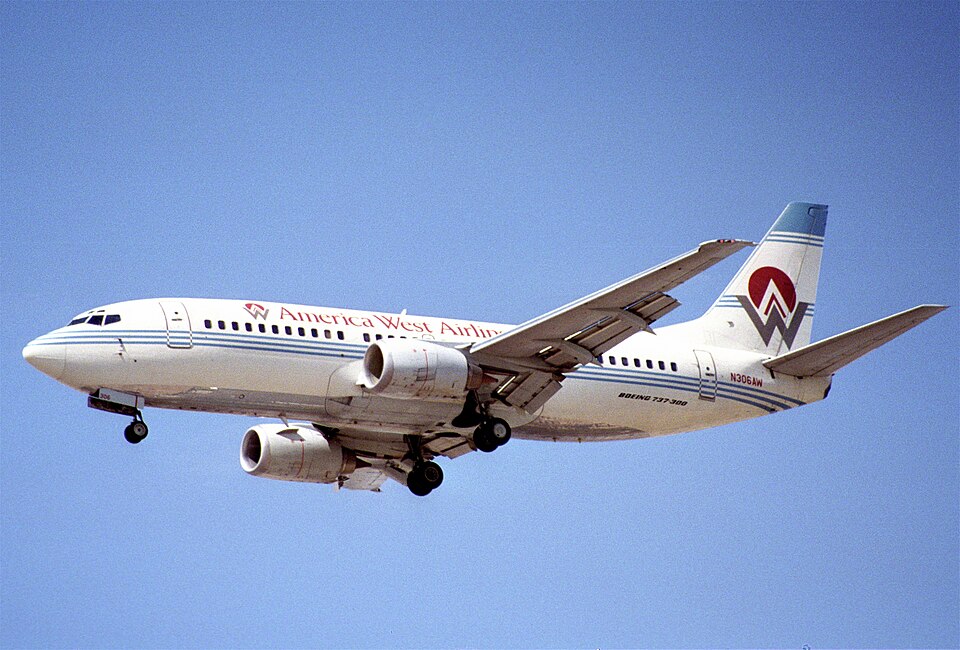
The accident on 1990-03-17 involved a Boeing 737-300, registration N306AW, operated by America West Airlines, at Santa Ana, CA.

What was the probable cause of the accident?

The flight crew's excessive rotation rate during takeoff, which exceeded the operational manual limit of 3 degrees per second, resulting in a tail strike and substantial damage to the pressure bulkhead.

Investigation report by the U.S. National Transportation Safety Board (NTSB) historical archive. Original record: https://carol.ntsb.gov/event/20001212X22748. This page is a structured re-presentation; facts and quotes are in the National Transportation Safety Board (NTSB), United States.

Loading the flight search…