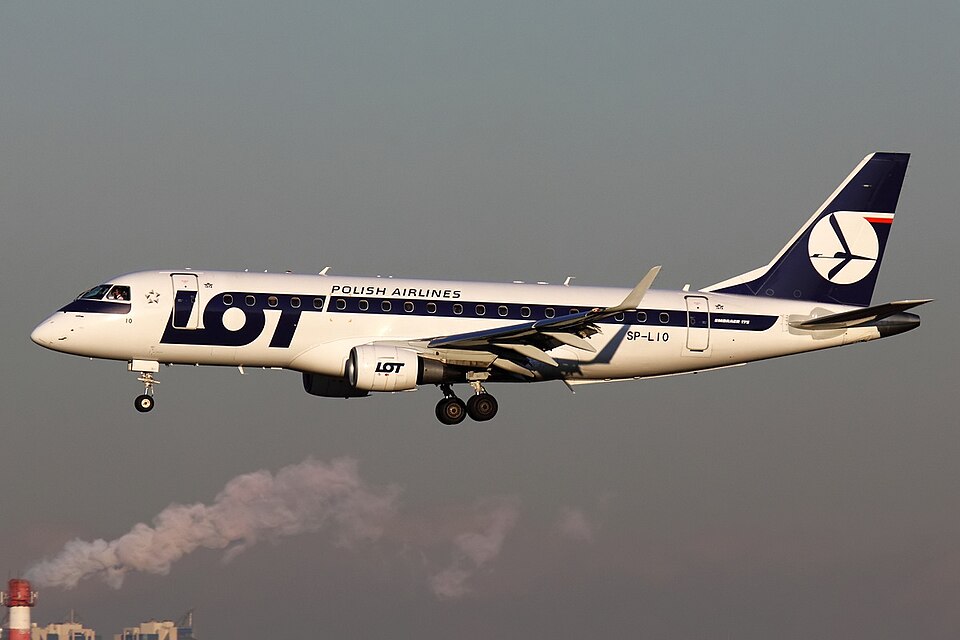
What happened
On November 1, 2017, an Embraer ERJ-175LR was operating a scheduled flight from Venice (LIPZ) to Warsaw (EPWA). During the landing on runway 33, the aircraft experienced a high vertical acceleration, recorded at 2.12 G with a mass of 31,298 kg.
While the flight crew did not file an Air Safety Report (ASR) or record the event in the maintenance log (LDP-60) at the time—as they did not perceive the landing to be hard—a subsequent Flight Data Monitoring (FDM) analysis performed on November 5, 2017, identified the excessive vertical G-load. Following this discovery, the operator's Maintenance Control Center (MCC) requested a special inspection of the main landing gear from the MRO organization. During the second phase of this inspection, conducted on November 8, 2017, technicians discovered a bent rod on the left inner flap and a crack in the lower structure (doubler) of the flap near the trailing edge.
The investigation
The investigation focused on the FDM data that flagged the vertical acceleration anomaly. The PKBWL examined the maintenance records, including the deferred inspection phases, and the physical damage found during the specialized inspection of the aircraft's flaps and landing gear. The investigation also reviewed the meteorological conditions at Warsaw (EPWA) at the time of arrival, which indicated low ceilings (BKN006) and light rain.
Findings
- The primary cause of the incident was a delayed flare, which resulted in a hard touchdown and a subsequent bounce.
- The aircraft sustained structural damage, specifically a bent rod and a crack in the flap doubler.
- The flight crew failed to report the event through the standard ASR or LDP-60 procedures because they did not subjectively identify the landing as a hard landing.
Safety action
- The incident was recorded in the operator's Safety Management System (SMS) database.
- The crew was reminded of the requirement to document any suspicious landings in the LDP-60 log.