Accident Overview
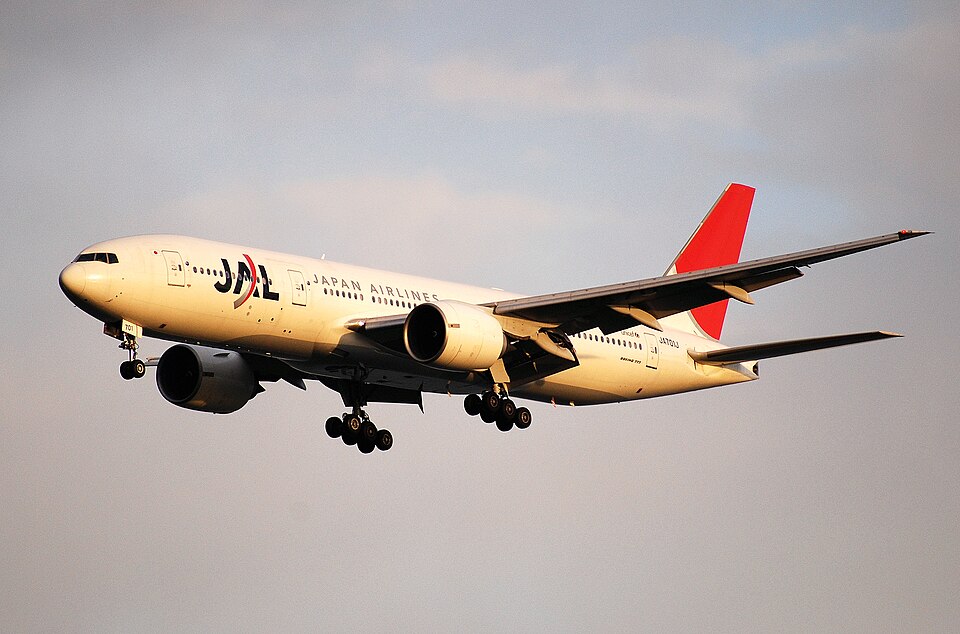
On Saturday, March 31, 2012, a Boeing 777-200, registered JA701J, operated by Japan Airlines Co., Ltd., was operating as a scheduled flight from Shanghai Hongqiao International Airport to Tokyo International Airport. During the approach to Runway 34L, after touchdown, the crew initiated a go-around. At approximately 16:08 Japan Standard Time, the lower part of the aft fuselage contacted the runway, resulting in damage to the airframe. The aircraft subsequently landed safely at Tokyo International Airport at 16:35. There were 308 persons on board—a captain, 11 crew members, and 296 passengers—and no injuries occurred. There was no fire.
Flight History
The approach and landing sequence were recorded by the Digital Flight Data Recorder (DFDR) and Cockpit Voice Recorder (CVR). The captain served as Pilot Monitoring (PM) and the first officer as Pilot Flying (PF). The aircraft received a landing clearance for Runway 34L at 16:01:34, and the crew was informed of wind shear reported at 800 feet. At 16:07:56, the aircraft crossed the runway threshold at an airspeed of 152 knots and a radio altitude of 41 feet. Touchdown on the right main landing gear occurred at 16:08:04, with the spoilers deploying and thrust levers retarded. The first officer's control column was pulled pitch-up, while the captain's was pushed pitch-down. At 16:08:05, after left main landing gear touchdown, the load on that gear momentarily reduced to zero, and the reverse thrust levers were raised. The captain called "Go around, Go around" at 16:08:06. The control columns were then pulled pitch-up, and the pitch angle increased rapidly. The tail strike caution was issued at 16:08:21 at a pitch angle of 11.0 degrees. The aircraft had traveled about 1,710 meters from the runway threshold at that time. Engine thrust began to increase, and the crew continued the go-around. The aircraft landed uneventfully after the event.
Damage and Injuries
The aircraft sustained substantial damage to the lower aft fuselage. No injuries were reported among the 308 occupants. There was no fire.
Probable Cause
The Japan Transport Safety Board determined that the accident was highly probable due to the aircraft continuing to roll with a pitch-up attitude after touchdown, causing the aft fuselage to contact the runway. This pitch-up attitude persisted because the captain, believing the aircraft had bounced sufficiently to warrant a go-around, chose to go around to avoid a hard landing. Even after becoming aware that the reverse thrust levers had been raised, he continued the go-around, leading to a delay in engine thrust increase and continued back pressure on the control column. Additionally, it was somewhat likely that the captain had been assisting the first officer's control inputs without formally declaring a takeover, leading to a momentary lack of clarity in pilot monitoring duties, including the monitoring of pitch angle and speed.