Incident Overview
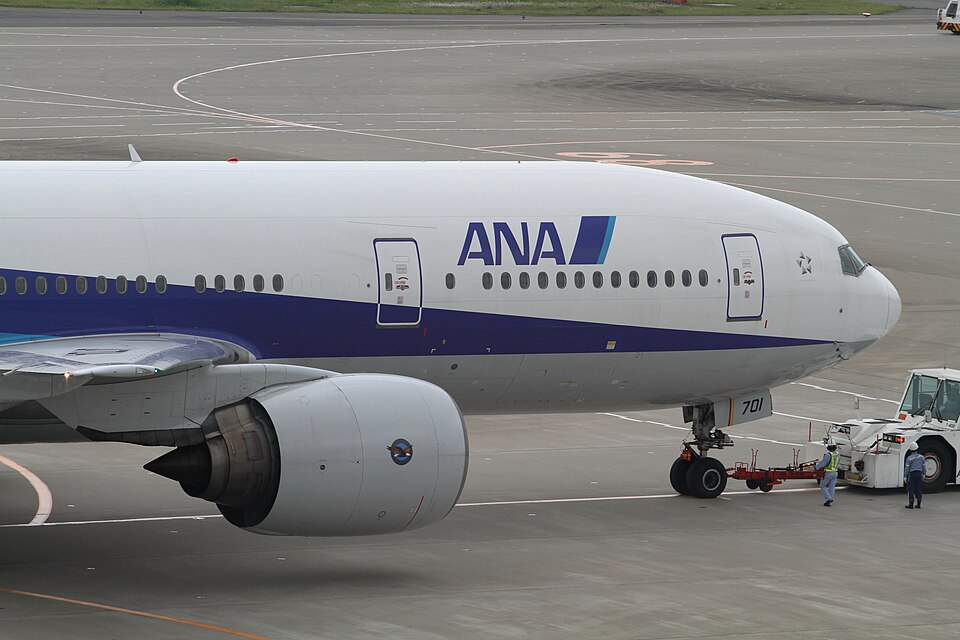
On December 13, 2013, at around 08:44 Japan Standard Time, an All Nippon Airways Boeing 777-200, registration JA701A, experienced a serious incident while climbing to cruising altitude. The aircraft, operating as scheduled Flight 243 from Tokyo International Airport to Fukuoka Airport, had departed at approximately 08:29. At an altitude of about 32,600 ft and approximately 90 km west of Tokyo International Airport, the flight instruments indicated a thrust decrease in the No.2 (right) engine along with an increase in exhaust gas temperature. The engine was shut down, and the aircraft returned to Tokyo International Airport, landing at 09:15 after obtaining priority from air traffic control.
Damage to Aircraft
The incident resulted in slight damage to the aircraft, primarily to the interior of the No.2 engine. The engine, a Pratt & Whitney PW4074 two-spool turbofan, sustained damage across the high pressure compressor (HPC). Examination of the HPC revealed that all first stage blades (stage 5) were severely damaged around the entire periphery of the disk. All blades were either fractured at the airfoil roots or missing from the slots. Additionally, all second stage blades (stage 6) were fractured at the airfoil roots. Damage was also observed in areas aft of the second stage blades, likely caused by fractured debris from the first and second stages. The combustion chamber and downstream components showed evidence of abnormal combustion and damage from fractured blades.
Analysis of Blade Failure
Investigation focused on the first stage HPC disk and blades. The disk has 40 slots, each holding a blade with a dovetail fitting secured by blade lock fittings. In 16 slots, blades had completely fallen off; in the remaining 24 slots, blade parts (dovetails and platforms) remained, but airfoils were fractured. Among the 24 slots with remaining parts, 16 were missing blade lock fittings, while 8 retained them. Severe scratch marks were found on the bottom surfaces and flanks of most slots in the rotation direction, except for one slot with abnormal damage on the reverse flank. This slot had minimal damage on the bottom and rotation-direction flank, leading investigators to consider that the blade originally installed in that slot may have been the origin of the failure.
Probable Cause
It is highly probable that the serious incident occurred because the engine interior was damaged due to the damage of the blades around the entire periphery of the first stage disc of HPC (stage 5) of the No.2 Engine (the right engine) during the flight. With regard to the damage of the blades around the entire periphery of the first stage disc of HPC, it is somewhat likely that one of the blades was damaged at the dovetail part and fell off from the slot.
Personnel and Aircraft Information
No injuries were reported among the two pilots and any other persons. The pilot in command was a 62-year-old male with a Boeing 777 type rating, and the first officer was a 47-year-old male with the same rating. The aircraft, a Boeing 777-200 (serial number 27938, manufactured July 9, 1997), was equipped with two Pratt & Whitney PW4074 engines. The No.2 engine had accumulated 33,661 hours and 24,176 cycles since manufacture, and 5,057 hours since last overhaul.