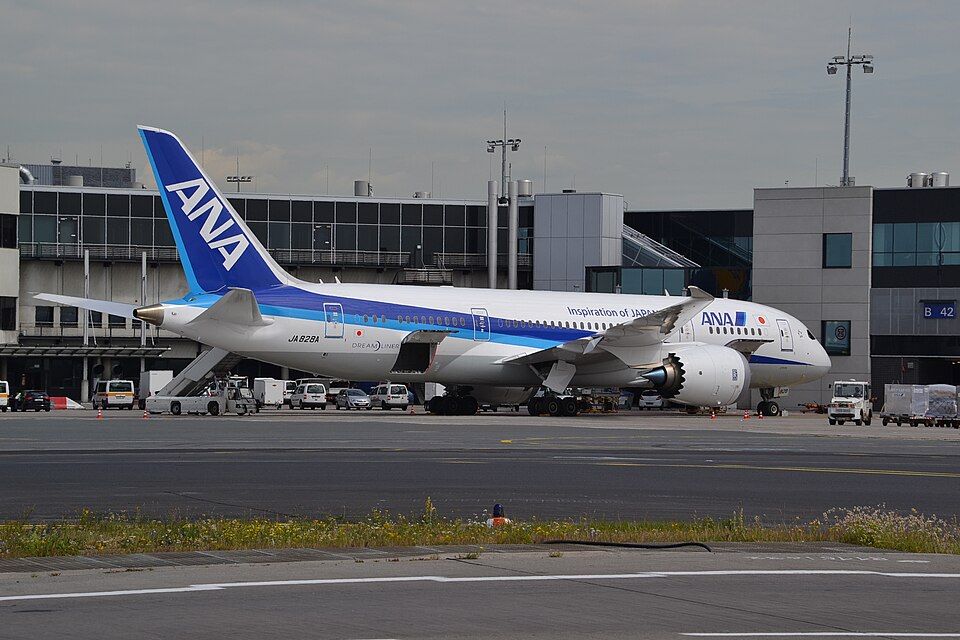
Incident Overview
On June 1, 2019, a Boeing 787-8, registered JA828A, operated by All Nippon Airways Co., Ltd., was en route from San Jose International Airport, USA, to Narita International Airport, Japan, as scheduled flight 171. While cruising at Flight Level 430 over the Pacific Ocean, approximately 280 nautical miles northeast of Narita, both air conditioning systems became inoperative, classified as a serious incident under Japanese regulations.
Flight History
The aircraft departed San Jose at 04:32 Japan Standard Time (JST) with 163 people on board, including the pilot in command, 11 other crewmembers, and 151 passengers. The flight proceeded normally until the aircraft gradually decelerated from Mach 0.84 to Mach 0.78 to adjust arrival time. At 13:56:49, the Engine Indicating and Crew Alerting System (EICAS) displayed a "PACK L" message, indicating the left-side air conditioning pack had failed. The pilot in command checked the Multi-Function Display Unit (MFDU) and found both Cabin Air Compressors (CACs) for the left pack had shut down.
At 14:00:17, following the company's aircraft operations manual, the pilot attempted to reset the air conditioning system by pushing the reset switch. This temporarily restored the left pack, but at 14:02:13, EICAS displayed "PACK L+R," indicating both packs were inoperative. All four CACs (L1, L2, R1, R2) had shut down, disabling both left and right air conditioning systems.
Crew Response
Upon the dual pack failure, the aircraft began descending from FL 430 at 14:02:52, monitoring the cabin altitude rate. At 14:08:00, at FL 277, the cabin altitude reached approximately 10,000 ft, triggering a "CABIN ALTITUDE" EICAS message. The pilot in command declared an emergency and executed an emergency descent. The aircraft reached a maximum cabin altitude of about 11,400 ft at 14:12:55 while descending. The flight continued at around 10,000 ft and landed safely at Narita International Airport at 14:56.
Aircraft and Systems Background
The Boeing 787-8 (serial number 42248, manufactured January 16, 2014) had accumulated 24,417 hours and 2,795 cycles. The air conditioning system uses CACs to compress outside air, which is then conditioned by packs before delivery to the cabin. A Pack Control Unit (PCU) monitors and controls the CACs for optimal efficiency. A surge control function is designed to prevent compressor surging, a phenomenon of airflow disturbance. The weather at the time was fine with jet stream winds but no turbulence. Post-flight inspection revealed no damage to the airframe.
No injuries to persons and no damage to the aircraft were reported.