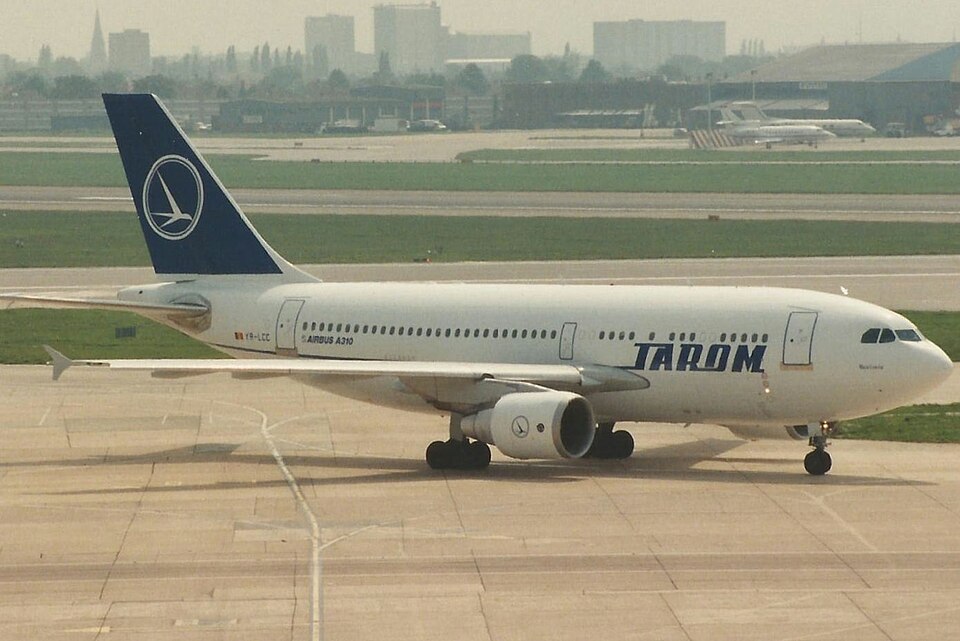
What happened
On a scheduled flight from Bucharest Otopeni Airport to Brussels, an Airbus A310 departed runway 08R at 09:04 local time. The crew, consisting of the captain and first officer, began the climb following de-icing procedures. Shortly after takeoff, while navigating toward the Strejnic VOR/DME beacon, a significant thrust asymmetry began to develop between the two engines. As the aircraft climbed through approximately 2,000 feet, the thrust from the left engine began to decrease steadily.
As the flight continued, the crew attempted to retract flaps and slats, but the imbalance between the engines worsened. By the time the aircraft reached roughly 4,620 feet, the bank angle was increasing sharply toward 43 degrees, and the pitch angle was dropping. During this period of instability, the autopilot disengaged, triggering a level 3 aural warning. The aircraft entered a steep dive with an increasing nose-down attitude. At approximately 09:08:28, the first officer noted that an engine had failed. The aircraft continued its descent at high speed, eventually impacting the ground at a pitch of roughly 50 degrees with both engines at idle power. The accident resulted in 60 fatalities.
Findings
Investigations identified several contributing factors to the loss of control. The primary technical issue was a significant thrust asymmetry between the engines. Additionally, investigators considered the possible incapacitation of the captain as a factor. It was also noted that the first officer failed to take sufficient corrective measures to manage the consequences of the engine imbalance. Some commentary suggested that the pilot's familiarity with different types of artificial horizon displays might have influenced the flight control responses during the emergency.