History of Flight
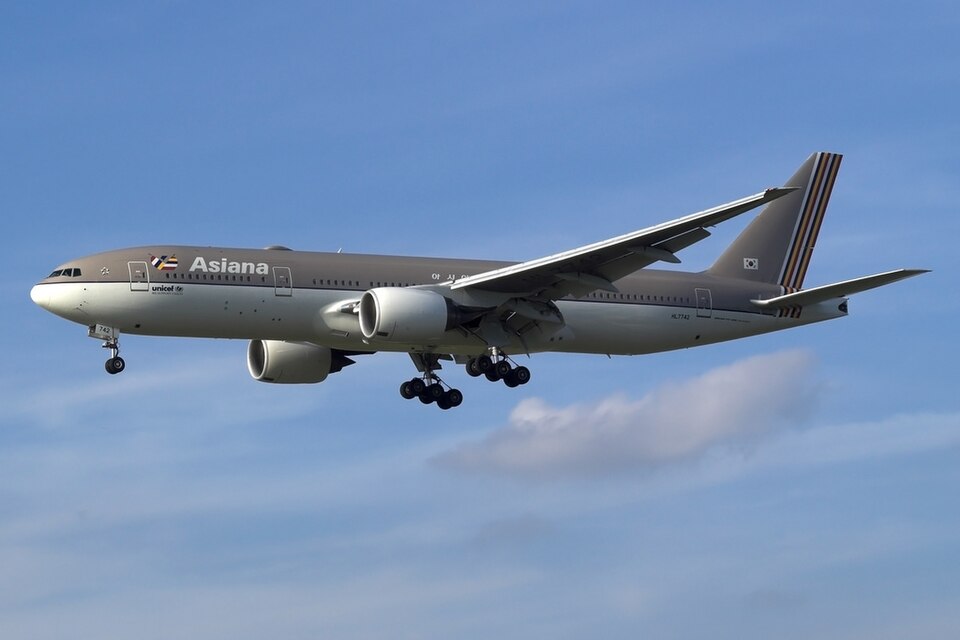
On July 6, 2013, Asiana Airlines Flight 214, a Boeing 777-200ER registered as HL7742, was on approach to runway 28L at San Francisco International Airport (SFO) in San Francisco, California. During the approach, the aircraft descended below the visual glidepath and impacted a seawall.
Injuries to Persons
Of the 291 passengers aboard, three sustained fatal injuries. Among the survivors, 40 passengers, 8 of the 12 flight attendants, and 1 of the 4 flight crewmembers received serious injuries. The remaining 248 passengers, 4 flight attendants, and 3 flight crewmembers sustained minor injuries or were uninjured.
Damage to Airplane
The airplane was destroyed by the impact and subsequent fire.
Personnel Information
The flight crew consisted of a pilot flying, a pilot monitoring, and an observer. The pilot flying and pilot monitoring had completed preaccident activities as per airline procedures. The observer was also present in the cockpit. The flight attendants included 12 individuals, with 8 seriously injured.
Aircraft Information
The accident aircraft was a Boeing 777-200ER, manufactured with advanced autoflight systems, including an autopilot flight director system and autothrottle. The flight mode annunciator and other cockpit displays were standard for the type.
Meteorological and Navigational Information
Meteorological conditions at the time were not detailed in the source. Navigational aids for runway 28L were available.
Flight Recorders
Both the cockpit voice recorder and flight data recorder were recovered and provided data for the investigation. A quick access recorder was also available.
Wreckage and Impact
The wreckage was consistent with a low-energy impact against the seawall, followed by a fire that destroyed much of the airframe.
Medical and Pathological Information
Toxicological tests on the flight crew were conducted; results were not specified in the abstract. The three fatalities were passengers, with injuries to survivors including spinal and other trauma.
Survival Aspects
Emergency response included aircraft rescue and firefighting (ARFF) operations. Issues identified included slide/raft performance, ARFF training, and communication problems during the response. Seatbelt compliance among passengers was not explicitly stated.
Safety Issues
The report identified safety issues related to pilot adherence to standard operating procedures, autoflight system complexity, training, low energy alerting, and emergency response procedures. Recommendations were made to the FAA, Asiana Airlines, Boeing, and others.
Probable Cause
The source does not explicitly state a probable cause in the provided excerpt.