Background
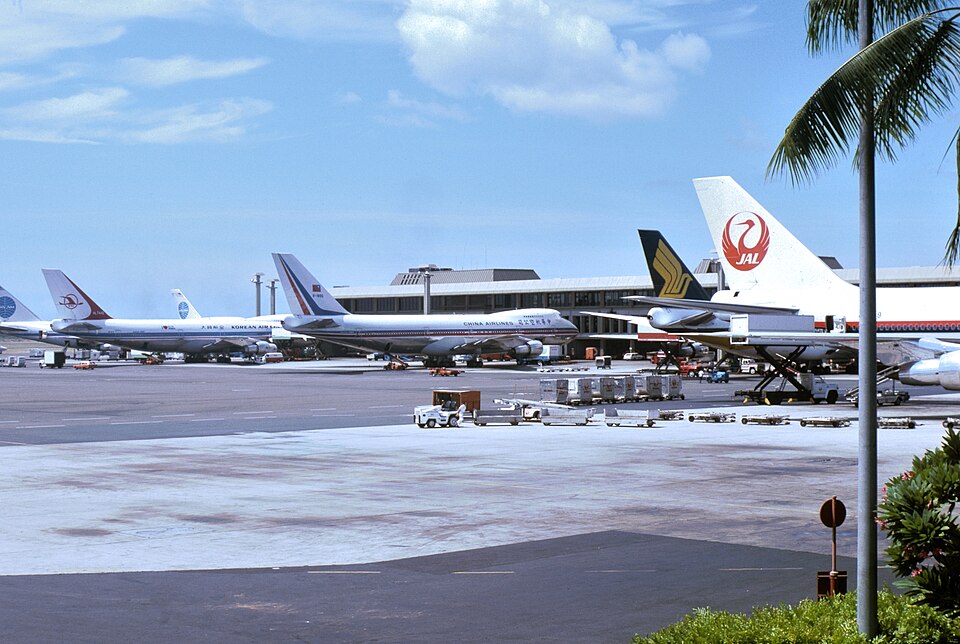
On 31 August 1983, Korean Air Lines (KAL) Flight 007, a Boeing 747, departed John F. Kennedy International Airport in New York, United States, on a scheduled one-stop flight to Kimpo International Airport in Seoul, Republic of Korea. The en-route stop occurred at Anchorage International Airport, Alaska, United States. At Anchorage, the aircraft was refueled and serviced. In accordance with company practice, the flight and cabin crews were changed. The flight departed at the planned time of departure, which was calculated for each KE 007 flight in keeping with Korean Air Lines' procedure. The departure from Anchorage was flexible to ensure arrival in Seoul at the scheduled arrival time of 21:00 hours (06:00 hours local time). The actual departure time of 13:00 hours on 31 August would have resulted in an on-time arrival had the flight been completed in accordance with its flight plan. On departing Anchorage, the flight had 269 persons on board: 240 passengers, 3 flight crew members, 20 cabin attendants, and 6 crew members of KAL being repositioned to Seoul.
Deviation
Soon after departure from Anchorage, KE 007 deviated to the right (north) of its direct track to Bethel. This deviation resulted in a progressively greater lateral displacement to the right of its planned route, which ultimately led to its penetration of adjacent high seas airspace in flight information regions operated by the Union of Soviet Socialist Republics (USSR), as well as sovereign USSR airspace overlying Kamchatka Peninsula and Sakhalin Island and their surrounding territorial waters. No evidence was found during the investigation to indicate that the flight crew of KE 007 was, at any time, aware of the flight's deviation from its planned route, despite the fact that it continued for over five hours.
According to representatives of the United States, military radar installations in Alaska were not aware in real time that the aircraft was proceeding west with an increasing northerly deviation from the recognized airways system. The military radar installations of the Japanese Defence Agency were aware that an aircraft was tracking in USSR airspace over Sakhalin Island. According to representatives of Japan, they were not aware that it was a civil aircraft off its intended track.
Interception
Approximately between 16:40 and 17:08 hours, military aircraft operated by the USSR attempted to intercept KE 007 over Kamchatka Peninsula. The interception attempts were unsuccessful. From about 18:00 hours, when KE 007 was approaching Sakhalin Island, USSR, the flight was intercepted by USSR military aircraft. At 18:26:02 hours, the aircraft was hit by at least one of two air-to-air missiles fired by the pilot of one of the USSR interceptor aircraft who had been directed, by his ground command and control units, to shoot down an aircraft which they assumed to be a United States RC-135.
Attack and Wreckage
As a result of the attack, KE 007 collided with the sea and sank off the southwest coast of Sakhalin Island. There were no survivors. The flight recorders, fragmentary pieces of the aircraft, and a small number of items of personal property were salvaged by divers from the USSR during a two-month period following the accident. In addition, some flotsam from the aircraft was dispersed by tidal currents and recovered later.
Investigation Findings
The cockpit voice recorder (CVR) and digital flight data recorder (DFDR) tapes were recovered by the USSR in 1983 and were handed over to the International Civil Aviation Organization (ICAO) in January 1993 by representatives of the Russian Federation. They also made available recordings and transcripts of the communications between the pilots of the intercepting fighter aircraft and their ground controllers, as well as communications between command centers. Representatives of the United States made available certified copies and transcripts of the Anchorage ATC tapes, and representatives of Japan made available the Tokyo ATC tape. In the course of the investigation, all practical steps were taken to confirm the authenticity of the communications tapes. A comprehensive assessment of the physical characteristics of the CVR and DFDR tapes and the information recorded on them was made to ensure they contained authentic records. The material on the communications tapes and the CVR and DFDR tapes showed no evidence of contradiction with known information and correlated well with other sources of data.
There was no evidence to suggest that the crew of flight KE 007 was aware that their aircraft was flying to the north of its planned route or that they knew of the presence of the intercepting fighter aircraft. The DFDR record established that flight KE 007 maintained a constant magnetic heading from soon after departure from Anchorage until the attack by the fighter aircraft. The maintenance of the constant magnetic heading was so accurate it could only have resulted from the autopilot controlling the aircraft. The CVR and DFDR records also established that the aircraft did not sustain an extensive avionics or navigation systems failure or malfunction prior to the attack. The evidence obtained supported the hypothesis that the crew inadvertently flew virtually the entire flight on a constant magnetic heading. The maintenance of a constant magnetic heading and the resulting track deviation was due to the KE 007 crew's failure to note that the autopilot had either been left in heading mode or had been switched to INS when the aircraft was beyond the range (7.5 NM) for the INS to capture the desired track.
Concerning the interception and associated identification, signaling, and communications, the investigation found the following:
1. Interceptions of KE 007 were attempted by USSR military aircraft over Kamchatka Peninsula and made in the vicinity of Sakhalin Island.
2. The USSR command center personnel assumed that KE 007 was a United States RC-135 aircraft. KE 007's climb from FL 330 to FL350 during the time of the interception over Sakhalin Island was interpreted as being evasive action, thus further contributing to the USSR presumption that it was an RC-135 aircraft.
3. No attempt was made by the USSR to contact the crew of KE 007 by radio on the distress frequency 121.5 MHz or on any other VHF or HF frequency. However, the interceptor pilot was instructed by his ground control to attempt to attract the attention of the crew of the intruding aircraft by firing his aircraft's cannon and flashing its navigation lights. It was not possible to assess the distance of the interceptor aircraft from the intruder nor their relative positions when the interceptor's lights were flashed and the cannon fired.
4. The USSR command center personnel on Sakhalin Island were concerned with the position of the intruder aircraft in relation to USSR sovereign airspace as well as its identity. The time factor became paramount as the intruder aircraft was about to coast out from Sakhalin Island. Therefore, exhaustive efforts to identify the intruder aircraft were not made, although apparently some doubt remained regarding its identity.
5. It was not possible to determine the position of KE 007 at the time of the missile attack in relation to USSR sovereign airspace.
Probable Cause
The considerable lateral deviation of the B-747 aeroplane on Flight KAL-007 from the assigned airway R20 was a result of the crew using an air navigation method based on maintaining a constant magnetic heading immediately after take-off (three minutes after the aeroplane lifted off) and throughout the whole of the subsequent flight. This basically contradicts the generally accepted standards and rules of air navigation, including the regulated documents of Korean Air Lines. Disregarding the need for multiple corrections of the magnetic heading, which were prescribed