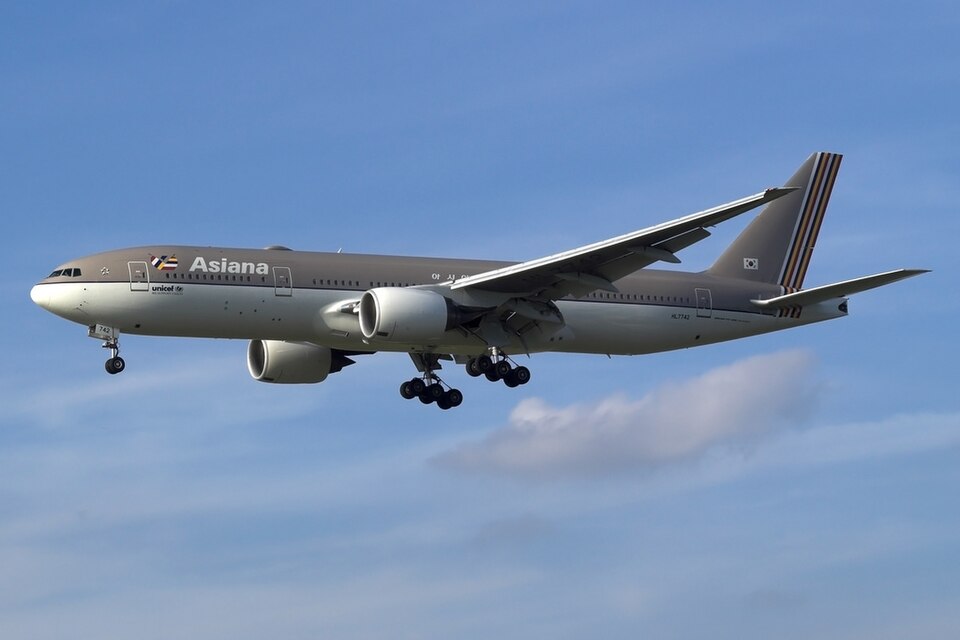
On July 6, 2013, a Boeing 777-200 (registration HL7742) operated by Asiana Airlines was involved in an aviation accident near San Francisco, United States of America during landing or approach. 3 people were killed. Investigators recorded the probable cause as: The National Transportation Safety Board determines that the probable cause of this accident was the flight crew’s mismanagement of the airplane’s descent during the visual approach, the pilot flying’s unintended deactivation of automatic airspeed control,… This summary draws on records from the Bureau of Aircraft Accidents Archives (B3A); 16 related events involving the same aircraft type or operator are linked below.
On July 6, 2013, Asiana Airlines Flight 214, a Boeing 777-200ER, struck a seawall during approach to SFO. Three passengers died, and 49 others were seriously injured. The NTSB cited crew mismanagement and delayed go-around.
Accident Overview and Casualties On July 6, 2013, at approximately 1128 Pacific daylight time, a Boeing 777-200ER with Korean registration HL7742, operating as Asiana Airlines Flight 214, struck a seawall while on approach to runway 28L at San Francisco International Airport (SFO). The aircraft was destroyed by impact forces and a subsequent postcrash fire. Three of the 291 passengers were fatally injured. Serious injuries were sustained by 40 passengers, 8 of the 12 flight attendants, and 1 of the 4 flight crewmembers. The remaining 248 passengers, 4 flight attendants, and 3 flight crewmembers suffered minor injuries or were uninjured. ## Flight Operations and Approach Flight 214 was a regularly scheduled international passenger flight from Incheon International Airport in Seoul, Korea, operating under 14 Code of Federal Regulations Part 129. Visual meteorological conditions prevailed, though an instrument flight rules flight plan had been filed. The flight was vectored for a visual approach to runway 28L and intercepted the final approach course about 14 nautical miles from the threshold, slightly above the desired 3° glidepath. After accepting an air traffic control instruction to maintain 180 knots to 5 nautical miles from the runway, the flight crew mismanaged the descent, leaving the aircraft well above the desired glidepath at the 5-nautical-mile point. ## Automation and Crew Actions In an attempt to increase the descent rate, the pilot flying selected an autopilot mode (flight level change speed) that instead caused the autoflight system to initiate a climb because the aircraft was below the selected altitude. The pilot flying disconnected the autopilot and moved the thrust levers to idle, causing the autothrottle to change to HOLD mode, a mode in which the autothrottle does not control airspeed. The pilot flying then pitched the aircraft down to increase the descent rate. Neither the pilot flying, the pilot monitoring, nor the observer noted the change in autothrottle mode to HOLD. ## Unstabilized Approach and Impact At 500 feet above airport elevation, the point at which Asiana’s procedures dictated the approach must be stabilized, the precision approach path indicator would have shown the aircraft slightly above the desired glidepath. The airspeed had just reached the proper approach speed of 137 knots, but the thrust levers were still at idle and the descent rate was about 1,200 feet per minute, well above the approximately 700 feet per minute needed to maintain the desired glidepath. These were two indications that the approach was not stabilized. The flight crew should have determined the approach was unstabilized and initiated a go-around, but they did not. As the approach continued, it became increasingly unstabilized as the aircraft descended below the desired glidepath; the precision approach path indicator displayed three and then four red lights. The decreasing airspeed trend continued, and about 200 feet, the flight crew became aware of the low airspeed and low path conditions but did not initiate a go-around until the aircraft was below 100 feet, at which point it did not have the performance capability to accomplish a go-around. The flight crew’s insufficient monitoring of airspeed indications resulted from expectancy, increased workload, fatigue, and automation reliance. ## Impact Sequence and Evacuation When the main landing gear and aft fuselage struck the seawall, the tail of the aircraft broke off at the aft pressure bulkhead. The aircraft slid along the runway, lifted partially into the air, spun about 330°, and impacted the ground a final time. The impact forces exceeded certification limits and resulted in the inflation of two slide/rafts within the cabin, injuring and temporarily trapping two flight attendants. Six occupants were ejected during the impact sequence: two of the three fatally injured passengers and four of the seriously injured flight attendants. The four flight attendants were wearing their restraints but were ejected due to the destruction of the aft galley where they were seated. The two ejected passengers were not wearing their seatbelts and would likely have remained in the cabin and survived if they had been wearing them. After the aircraft came to a stop, a fire initiated within the separated right engine, which came to rest adjacent to the right side of the fuselage. When one of the flight attendants became aware of the fire, he initiated an evacuation, and 98% of the passengers successfully self-evacuated. As the fire spread into the fuselage, firefighters entered the aircraft and extricated five passengers (one of whom later died) who were injured and unable to evacuate. Overall, 99% of the aircraft’s occupants survived.
Probable cause
The National Transportation Safety Board determines that the probable cause of this accident was the flight crew’s mismanagement of the airplane’s descent during the visual approach, the pilot flying’s unintended deactivation of automatic airspeed control, the flight crew’s inadequate monitoring of airspeed, and the flight crew’s delayed execution of a go-around after they became aware that the airplane was below acceptable glidepath and airspeed tolerances. Contributing to the accident were: (1) the complexities of the autothrottle and autopilot flight director systems that were inadequately described in Boeing’s documentation and Asiana’s pilot training, which increased the likelihood of mode error; (2) the flight crew’s nonstandard communication and coordination regarding the use of the autothrottle and autopilot flight director systems; (3) the pilot flying’s inadequate training on the planning and executing of visual approaches; (4) the pilot monitoring/instructor pilot’s inadequate supervision of the pilot flying; and (5) flight crew fatigue, which likely degraded their performance.