Background
The Angkasa Pura I Branch Office Surabaya, operator of Juanda International Airport, planned runway maintenance to be conducted at night after runway operations. A NOTAM (A0888/14) stated that runway 10/28 would be closed daily from 0100 to 0459 local time from 2 May to 26 June 2014 due to work in progress.
Event
On 11 June 2014, at 0100 LT, the Airport Facility Readiness team began the runway maintenance program, which included patching the runway surface. The work was performed by another company with 10 personnel using tools such as a pneumatic compressor, jack hammer, chisel, high air pressure hose, asphalt mixer, small container for asphalt mixture, debris sweeper, and other equipment.
At 0405 LT, ARFF personnel and Airport Facility Readiness personnel conducted a runway readiness check and airside patrol. At 0430 LT, they reported to Juanda Tower that the runway was clear except near intersection N3 where repair was still in progress. At 0450 LT, the airport maintenance team reported that the repair had finished and the team had left the runway. No runway inspection was performed after the repair.
Airport operations resumed at 0500 LT. Between 0500 and 0606 LT, 11 aircraft departed and one arrived, with no pilot reporting foreign objects on the runway. At 0609 LT, a pilot reported objects near taxiway N5, after sunrise at 0559 LT, indicating the objects were not clearly visible during darkness.
At 0615 LT, the controller contacted ARFF personnel to check the reported objects. When the ARFF vehicle arrived near the runway, the controller instructed it to wait for three landing aircraft.
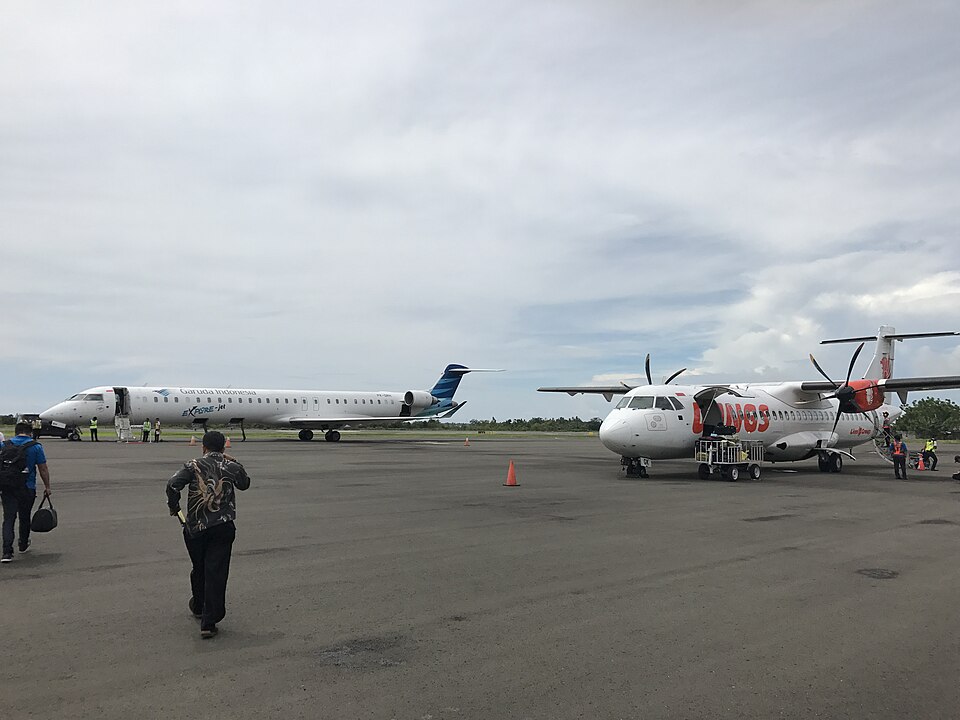
At 0620 LT, an ATR 72-212A (600 version) registered PK-WGK, operating as flight IW1861, landed and struck a chisel, resulting in eight holes on the lower fuselage. At 0623 LT, the controller closed the runway and instructed ARFF personnel to inspect it. They found a compressor hose (about 10 meters long), a jack hammer (about 60 cm long), and a chisel (about 4.5 kg) on the runway.
Investigation Findings
The investigation concluded that the contributing factors were:
- The runway inspection performed while maintenance was not finished resulted in objects of dark color on a dark surface not being properly inspected.
- Insufficient information regarding the objects and their location may have led to improper assessment of the consequences of runway operation and delayed removal of the objects.
Recommendations
The KNKT issued safety recommendations to PT. Angkasa Pura I Branch Office Juanda International Airport and Airnav Indonesia Branch Office Juanda.