History of the Flight
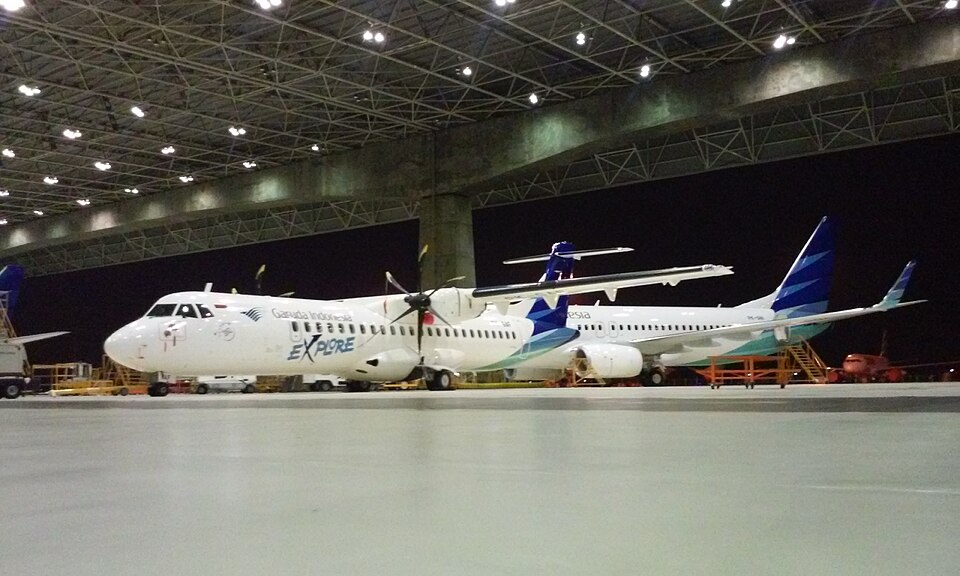
On 19 October 2015, an ATR 72-212A aircraft, registered PK-GAF, operated by PT. Garuda Indonesia as a scheduled passenger flight from Kupang to Ende. The flight was uneventful until the approach to Ende. The Pilot in Command (PIC) acted as pilot flying, and the Second in Command (SIC) acted as pilot monitoring.
At 0537 UTC, the SIC advised Ende Aeronautic Communication Officer (ACO) that the aircraft was turning final for runway 27. The ACO reported wind from 150° at 18 knots and that the runway was clear. Weather was clear with no scattered cumulus. On short final, the SIC noted the wind sock consistent with the reported wind.
Landing and Events
The aircraft touched down on the touchdown zone with the nose wheel contacting the runway first, causing a bounce to the left of the runway centerline. A second touchdown occurred on the left shoulder of the runway. During the second bounce, the master warning illuminated, displaying a "Pitch Disconnect" warning on the Engine and Warning Display (EWD). The flight crew applied significant dual and opposite control column inputs: pitch down by the PIC on the left seat and pitch up by the SIC on the right seat (which has higher pitch authority), leading to pitch uncoupling mechanism activation.
Go-Around and Diversion
After the second bounce, the Flight Data Recorder (FDR) recorded increasing torque (TQ) values. The pilot executed a go-around, turning right to avoid obstacles at the end of runway 27. Both pilots assessed the situation and decided to divert to Labuan Bajo. The flight continued uneventfully and landed safely there.
Aircraft and Operational Information
The investigation determined that aircraft airworthiness and serviceability were not factors in this occurrence. The ATR 72-212A (PK-GAF) was properly maintained. The flight crew were qualified: the PIC held an Airline Transport Pilot License, and the SIC held a Commercial Pilot License. The operator, Garuda Indonesia, had established stabilized approach criteria, landing techniques, and procedures for pitch disconnect, bounce landing, and go-around.
Conclusions
The investigation identified findings related to the landing technique and pilot coordination. Contributing factors included the nose-wheel-first touchdown leading to the bounce and subsequent dual opposite control inputs. No safety recommendations were issued by the KNKT in this report.