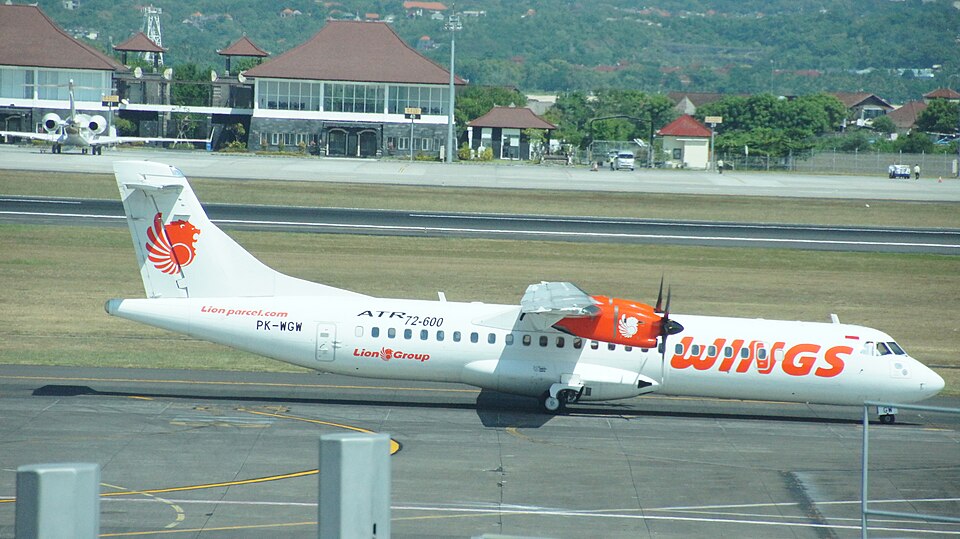
Overview
On 25 December 2016, an ATR 72-600 aircraft registered PK-WGW, operated by PT. Wings Abadi Airlines (Wings Air), was conducting scheduled passenger flight WON 1896 from Husein Sastranegara International Airport (WICC), Bandung, to Ahmad Yani International Airport (WAHS), Semarang. On board were two pilots, two flight attendants, and 68 passengers. There was no report or record of aircraft system malfunction prior to departure.
Flight Sequence
The aircraft departed Bandung at 1734 local time (1034 UTC). The Pilot in Command acted as Pilot Flying, and the Second in Command acted as Pilot Monitoring. The flight was uneventful until the approach to Semarang.
At 1112 UTC, during night conditions, the Semarang Approach controller informed all traffic that rain was falling over the airport. The pilot inquired whether the rain was heavy and was told it was slight rain. At 1115 UTC, the flight held over waypoint KENDA at 4,000 feet for separation. Two minutes later, clearance was given to descend to 3,000 feet. At 1118 UTC, the approach controller cleared the flight for an RNAV approach to runway 13 and advised the pilot to report when leaving KENDA. One minute later, the pilot reported leaving KENDA, and the controller instructed the flight to continue the approach and contact Semarang Tower.
At 1120 UTC, the pilot advised the tower controller that the aircraft was on final and the runway was in sight. The tower controller instructed to continue the landing approach, advised surface wind 190° at 15 knots, altimeter setting 1,008 mbs, and that the runway was wet. At 1121 UTC, the tower controller had visual contact and issued landing clearance. The pilot read back the clearance and requested to reduce approach light intensity. The tower controller reduced it, confirmed the intensity was appropriate, and the pilot affirmed.
Landing and Accident
At 1124 UTC, the aircraft touched down and bounced. After the third bounce, the pilot attempted a go-around, but the aircraft touched the runway. The tower controller observed that the red light on the right wing was lower than the green light on the left wing. The aircraft moved right from the runway centerline and stopped near taxiway D. The tower controller pressed the crash bell and informed Airport Rescue and Fire Fighting (ARFF) personnel by phone that there was an aircraft accident near taxiway D.
At 1126 UTC, the pilot advised the tower that the aircraft had stopped on the runway and requested assistance. The tower acknowledged and advised the pilot to wait. While waiting, the pilot kept the engines running to provide cabin lighting. At 1129 UTC, the tower advised the pilot to shut down the engines as ARFF personnel had arrived to assist evacuation. Passenger evacuation was completed approximately 10 minutes after the aircraft stopped.
Probable Cause
Contributing Factors:
- The visual illusion of aircraft higher than the real altitude resulted in late flare out which made the aircraft bounced.
- The unrecovered bounce resulted in abnormal landing attitude with vertical acceleration up to 6 g and collapsed the right main landing gear.