History of the Flight
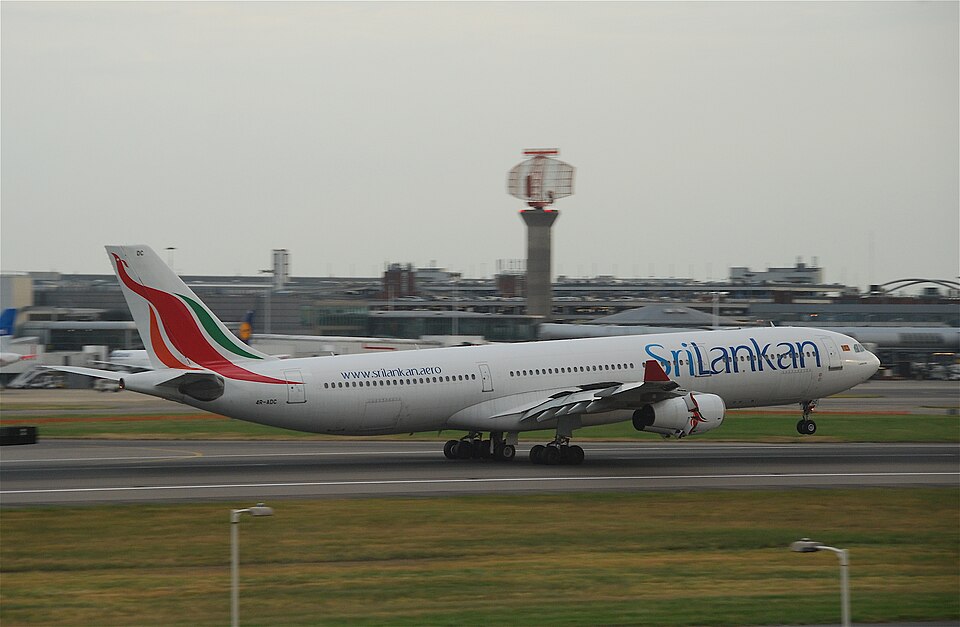
The crew of the Airbus A340-300, registration 4R-ADC, reported for duty at 1930 hrs after a rest period of about 36 hours. The flight deck comprised the commander in the left seat, an operating co-pilot in the right seat, and a relief co-pilot on a jump seat. The aircraft was prepared for departure, and the crew listened to the Heathrow ATIS broadcast. Pushback from the stand at Terminal 4 occurred at 2044 hrs, by which time it was dark. There was no significant weather, visibility was 8 km, and wind was south-westerly at about 10 kt.
After pushback and engine start, ATC cleared the A340 to taxi and hold short of Runway 27L. The co-pilot was the handling pilot, but the commander taxied the aircraft per company procedures. ATC then cleared the aircraft to cross Runway 27L and taxi to Holding Point A1, adjacent to Runway 27R. A Boeing 747-400, registration G-BNLL, ahead of the A340, had also been cleared to Holding Point A1. The B747 stopped temporarily on Link 23 behind a Boeing 777, leaving space to protect from jet blast and avoiding stopping in the turn ahead.
Prior to reaching Link 22, the A340 was transferred to departure frequency and re-cleared to Holding Point A2 via green centreline lights. The crew understood this as no impediment to their progress. As the A340 approached the stationary B747, they briefly discussed separation; although concerned, they believed separation was adequate. The commander taxied left of the taxiway centreline as a precaution. The right wingtip of the A340 struck the winglet of the B747, and the co-pilot called for a stop.
The A340 crew informed ATC of a possible collision. The B747 crew felt a jolt but attributed it to jet blast from a B777 ahead. They saw the A340's proximity and a cabin crew member reported the left winglet being struck. They also advised ATC. The Airport Fire Service attended, confirmed damage but no fuel leak. Both aircraft were shut down and passengers deplaned normally without injuries.
Measurements
After the collision, the B747 was on Link 23, aligned with the taxiway centreline, 193 metres from Holding Point A1. The A340 was on Link 22, nosewheel 1.8 metres left of centreline, body gear 2.3 metres left. The point of contact was at the intersection of Links 22 and 23, with wingtip overlap of about 2 metres.
Aircraft Damage
The Boeing 747-400's left winglet was severed approximately 1.7 metres from its tip and was later replaced. The Airbus A340-300 had a fractured right wing navigation light assembly and damage to the leading edge of the right winglet. The damaged winglet was removed per the Minimum Equipment List, and the navigation light assembly replaced; the aircraft returned to service the following evening.
Procedures
The UK AIP for Heathrow, under Local Traffic Regulations, stated that ATC directions should be followed specifically, pilots should maintain a careful lookout, and that within holding areas, conditional clearances may entail overtaking and passing other aircraft, with avoidance responsibility on flight crews. The Heathrow Manual of Air Traffic Services required an ATIS message: "Pilots are to exercise caution when manoeuvring in the Runway Holding Areas as wing tip clearance is not assured." This message was introduced after a 1995 accident.
The crew of 4R-ADC confirmed hearing the ATIS message but misinterpreted it as a disclaimer by airport authorities. A senior pilot from the same operator considered it referred to lack of clearance between taxiing aircraft and obstructions. Another management pilot raised concerns that it was not possible to judge wingtip clearance from the flight deck when manoeuvring large aircraft.
Heathrow Airport Eastern Apron Development
The taxiway area had been recently redeveloped to provide Code F routes, increase holding areas, and reconstruct pavement. The design aimed to comply with CAP 168 guidance, with separation based on one aircraft per taxiway block between stopbars. The airport operator believed this guaranteed aircraft separation at all times, but the incident occurred within this design.