Flight Overview
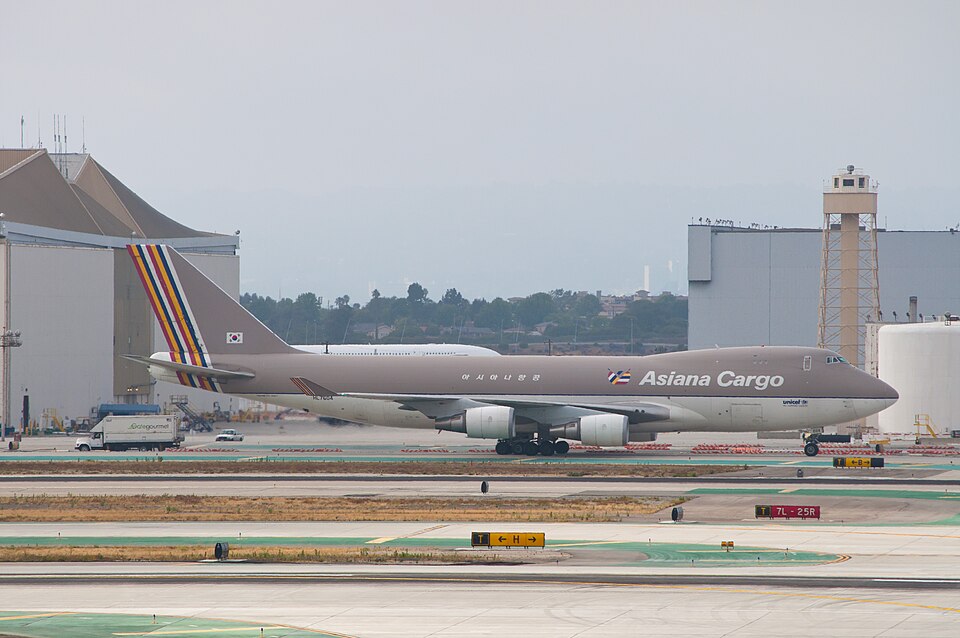
On 28 July 2011, Asiana Airlines Flight 991 (AAR991), a scheduled cargo flight from Incheon, Republic of Korea, to Shanghai, China, crashed into international waters approximately 130 km west of Jeju International Airport. The aircraft was a Boeing 747-400F, registration HL7604. The flight operated under instrument flight rules at night, in accordance with the Aviation Act of the Republic of Korea and the Convention on International Civil Aviation. Both the captain and first officer (FO) were fatally injured; the aircraft was destroyed, and cargo shipments were damaged, unrecoverable, or washed away.
Pre-Departure and Departure
The flight crew arrived at the Asiana Airlines crew room at Incheon International Airport one hour before the scheduled departure. The captain performed a ramp inspection around 02:00, and with the loadmaster, inspected dangerous goods and other cargo in the main deck cargo compartment. AAR991 took off from runway 15L at 03:04:28 KST. The captain handled initial radio communications.
En Route and Emergency Declaration
After takeoff, AAR991 contacted Seoul Area Control Center (SEL ACC) and was instructed to climb to 34,000 ft. The flight later transferred to Incheon Area Control Center (ICN ACC) and then to Shanghai Area Control Center (SHI ACC) around 03:51. At 03:52, SHI ACC instructed a 5-mile offset right of track, which the crew executed. Around 03:53, the Aircraft Communications Addressing and Reporting System (ACARS) transmitted messages including "EQUIPMENT SMOKE," "EQUIP COOLING," and multiple cargo detection alerts. At 03:54:23, the FO declared an emergency due to a fire on the main deck and requested descent to 10,000 ft. SHI ACC cleared the descent and approved a diversion to Jeju Airport.
Descent and Communications
The aircraft began descending at 03:54:59. At 03:55, the FO confirmed the diversion to Jeju. At 03:58, SHI ACC instructed AAR991 to maintain 10,000 ft, but received no response. A nearby aircraft, KAL886, relayed that AAR991 was descending to 10,000 ft. At 03:59:13, AAR991 requested a radar vector to Jeju, and SHI ACC provided heading 045, which was acknowledged. ACARS messages continued, including "YAW DAMPER UPR," "RUD RATIO DUAL," and "FLAPS CONTROL" around 04:00.
Final Moments
At 04:01:43, radar data showed AAR991 at 8,200 ft, 404 knots, heading 033°, then inconsistent changes. At 04:02:10, the FO transmitted a mayday to Fukuoka Control (FUK ACC), reporting a cargo fire and requesting direct to Jeju. No response was received. At 04:03:01, the transponder code changed to 7700. KAL886 relayed instructions from ICN ACC: maintain heading 060, radar vector, descend to 7,000 ft. The captain acknowledged at 04:05:52, then reported rudder control not working and heavy vibration. At 04:09:47, the captain told Jeju Approach that rudder and flight controls were not working. At 04:10:06, the FO stated the aircraft had heavy vibration and may need to ditch, adding that altitude control was not available. Jeju Approach asked if the aircraft could make an approach, but no response was received after 04:10:26. The aircraft crashed at approximately 04:11 KST.